



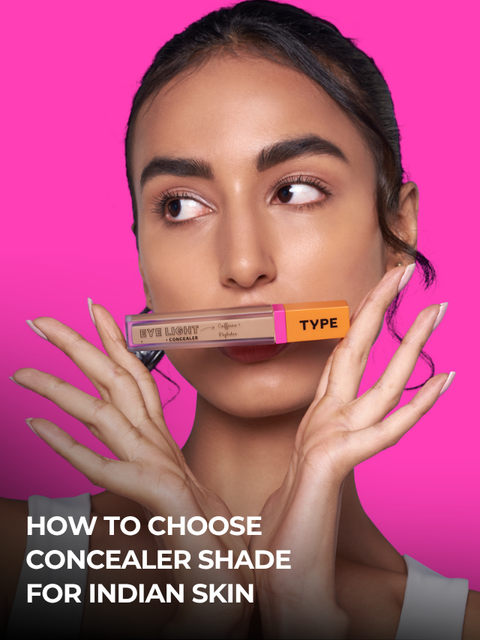
How to Choose Concealer Shade for Indian Skin: A Complete Beginner's Guide
Choosing the right concealer for Indian skin starts with identifying your undertone, understanding what you want to conceal, and selecting the correct shade for that purpose. For blemishes, choose a concealer that matches your foundation or natural skin tone. For under-eye brightening choose a concealer that is one to two shades lighter while maintaining the same undertone. This brightens the eye area without creating an unnatural contrast. Pairing it with the right eye makeup products can help brighten the whole eye area further.
If you've ever wondered how to choose concealer shade for Indian skin you're not alone. Indian skin tones range from fair to deep with warm neutral cool and olive undertones making shade selection more nuanced than simply choosing light medium or dark. The right concealer blends seamlessly brightens where needed and covers imperfections without looking grey or ashy. Browsing our range of face makeup products can help you find pieces that complement your concealer.
At Type Beauty, makeup is designed with a skincare-first approach. The Get Even Concealer is formulated to help improve the appearance of dark circles, pigmentation, and uneven skin tone while delivering buildable, natural-looking coverage. Whether you're buying your first concealer or looking for a better match, this guide will help you make a confident choice.
Why Choosing the Right Concealer Shade Matters
A well-matched concealer does much more than cover imperfections. It creates a smooth, even-looking complexion and helps your makeup appear more natural.
Choosing the correct shade can help you:
- Cover dark circles without creating a grey cast
- Conceal acne marks and pigmentation more effectively
- Blend seamlessly with your foundation
- Brighten specific areas of the face naturally
- Create a fresh, balanced makeup look
On the other hand a concealer that's too light too dark or the wrong undertone can draw attention to the very areas you're trying to conceal. For persistent discolouration our guide on best concealers for dark circles on Indian skin can help you find a better match.
Understand Your Skin Tone Before Choosing a Concealer
One of the biggest mistakes people make when learning how to choose concealer shade for Indian skin is focusing only on skin tone. According to Type Beauty's shade guide identifying your undertone is equally important for achieving a seamless match. If you're deciding between formulas our comparison of liquid vs cream concealers can help you choose the right texture for your skin.
Skin Tone vs Undertone
Your skin tone refers to the surface colour of your skin, which may be fair, light, medium, tan, or deep.
Your undertone is the subtle colour beneath your skin that remains consistent regardless of tanning or seasonal changes.
Most Indian complexions fall into one of these undertones:
- Warm
- Neutral
- Cool
- Golden
- Peachy
- Olive
Some people may also have olive or golden undertones.
Three Easy Ways to Find Your Undertone
1. Check Your Veins
- Green-looking veins often indicate warm undertones.
- Blue or purple veins usually suggest cool undertones.
- A mix of both often points to neutral undertones.
2. Try the Jewellery Test
If gold jewellery flatters your complexion more, you may have warm undertones. If silver looks better, you may have cool undertones. If both suit you equally, your undertone is likely neutral.
3. Observe How Your Skin Reacts to the Sun
If your skin tans easily, you may have warm or olive undertones. If it burns before tanning, you may have cool undertones.
How to Choose Concealer Shade for Indian Skin Step by Step
Knowing how to choose concealer shade for Indian skin becomes much easier when you follow a simple process.
Step 1: Decide What You Want to Conceal
Different concerns may require different approaches.
For:
- Dark circles
- Acne marks
- Hyperpigmentation
- Blemishes
- Uneven skin tone
The ideal shade may vary depending on the level of coverage you need.
Step 2: Choose Based on the Purpose
For spot concealing, select a concealer that closely matches your skin tone.
For under-eye brightening, choose a concealer that is one to two shades lighter while maintaining the same undertone. This brightens the eye area without creating an unnatural contrast.
Step 3: Match Your Undertone
When learning how to choose concealer shade for Indian skin, undertone matching is essential.
- Warm undertones generally suit warm golden or peach-based shades.
- Neutral undertones work well with balanced neutral shades.
- Cool undertones pair best with cooler pink-beige shades.
Quick Concealer Shade Guide for Indian Skin
|
Your Undertone |
Under-Eye Concealer |
Spot Concealer |
|
Warm |
Warm golden or peach-toned shade, 1–2 shades lighter |
Match your foundation or skin tone |
|
Neutral |
Neutral shade, 1–2 shades lighter |
Neutral skin match |
|
Cool |
Cool pink-beige shade, 1–2 shades lighter |
Remember, these are general guidelines. Type Beauty also recommends testing your concealer on the jawline, checking it in natural daylight, and allowing it to settle before making your final shade choice. For a broader shade reference, see these quick shade charts for Indian skin.
Common Concealer Mistakes to Avoid
Even after understanding how to choose concealer shade for Indian skin, a few common mistakes can affect your final result.
Avoid these errors:
- Choosing the lightest shade available
- Ignoring your undertone
- Swatching only on your hand instead of your jawline
- Checking the shade only under artificial lighting
- Not waiting a few minutes to see if the concealer oxidises
- Buying a concealer only because it matches someone else's recommendation
Expert Tips for Finding Your Perfect Match
Professional makeup artists often recommend following a few simple habits when selecting concealer.
- Test shades on your jawline rather than your wrist.
- Look at the shade in natural daylight.
- Allow the product to settle for a few minutes before deciding.
- Blend it fully to see how it melts into your skin.
- Match your neck and face together for a more balanced finish.
- If you're unsure, use Type Beauty's Find Your Shade quiz to help identify your best match.
These small steps can make a significant difference in choosing the right product.
Concealer or Colour Corrector: Which One Do You Need?
Many people confuse concealers with colour correctors but they serve different purposes. If you're also weighing lighter alternatives our cc cream guide explains how it compares to concealer and colour correctors.
Use Concealer When:
- Covering mild dark circles
- Concealing blemishes
- Hiding acne marks
- Evening out small areas of pigmentation
Use a Colour Corrector First When:
- Dark circles appear blue or purple
- Pigmentation is particularly deep
- You have stubborn acne scars that show through regular concealer
A colour corrector neutralises discolouration before concealer is applied allowing you to use less product while achieving a smoother finish. Keeping a mini foundation on hand can also help you test how your concealer sits once foundation is applied.
Why Type Beauty Makes Shade Matching Easier
Choosing the right concealer shouldn't feel overwhelming. Type Beauty takes a skin-first approach by creating concealers that combine makeup with skincare-inspired ingredients, making them suitable for everyday wear.
The Get Even Concealer is enriched with Niacinamide, Vitamin C (3-O-Ethyl Ascorbic Acid), and Bakuchiol to help improve the appearance of dark spots and dullness while providing buildable coverage. The collection is designed to help address common concerns such as dark circles, uneven skin tone, and pigmentation while offering undertone-conscious shade options.
If you're unsure where to begin, the Type Beauty Find Your Shade quiz can help you narrow down shades that complement your complexion more accurately. Ready to browse formulas? Shop our concealer collection to get started.
Whether you're searching for lightweight everyday coverage or a concealer that blends naturally with your foundation, exploring the Type Beauty concealer collection is a great place to start.
Final Thoughts
When your concealer complements both your skin tone and undertone, the result looks fresh, balanced, and naturally radiant. Ready to put it into practice? See how to use concealer correctly for a full step-by-step guide.
Find Your Perfect Match with Type Beauty
Ready to simplify how to choose concealer shade for Indian skin? Explore Type Beauty's Get Even Concealer and Find Your Shade quiz to discover undertone-conscious options formulated with Niacinamide, Vitamin C (3-O-Ethyl Ascorbic Acid), and Bakuchiol to help improve the appearance of dark circles, pigmentation, and dullness while delivering natural-looking coverage.
Frequently Asked Questions
Q1. How do I choose the right concealer shade for Indian skin?
Start by identifying your undertone, then choose a concealer that matches your skin tone for blemishes or one to two shades lighter for brightening under the eyes.
Q2. How can I find my undertone at home?
You can use the vein test, jewellery test, or observe how your skin reacts to the sun to identify whether your undertone is warm, cool, or neutral.
Q3. Can I use the same concealer for dark circles and blemishes?
Yes, but many people achieve better results by using a slightly lighter shade for under-eye brightening and a skin-tone match for spot concealing.
Q4. Can I test concealer on my hand before buying?
Testing on your jawline or cheek is more accurate because the colour of your hands may differ from your face.
Q5. Is concealer supposed to be lighter than foundation?
Only for brightening the under-eye area. For covering blemishes or pigmentation, choose a concealer that closely matches your foundation or natural skin tone.
Q6. What is the most common undertone in Indian skin?
Many Indian skin tones have warm or neutral undertones, although cool and olive undertones are also common.
Q7. Why does my concealer look grey after application?
This usually happens when the undertone is incorrect or the shade is too light for your complexion.
Q8. Will the right concealer completely hide pigmentation?
A well-matched concealer can significantly reduce the appearance of pigmentation. For deeper discolouration, applying a suitable colour corrector first may provide better coverage.
Comments (0)
There are no comments for this article. Be the first one to leave a message!